AI adoption doesn’t usually break because people don’t care. It breaks because nobody knows who can say yes, who has to say no, and what happens when something feels ‘off.’
If you want the truth about AI in the mid‑market, it’s this: everybody is interested, but nobody wants to be blamed for a failed project, but they don’t want to be “that guy” who fell behind either.
That’s a rational reaction. AI touches customer communication, internal decision-making, and sensitive data. So, when ownership is vague, people either avoid using it- or use it quietly and hope nothing goes wrong.
The fix is surprisingly unsexy: assign ownership in a way that matches how work actually happens.
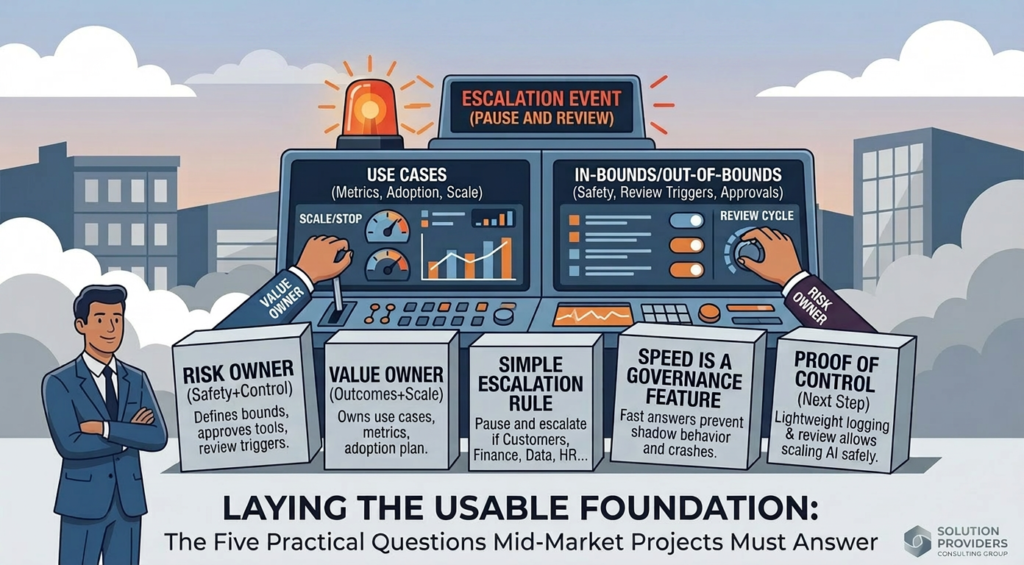
I like to separate ownership into two roles (they can be two people or one person wearing two hats):
- Risk Owner (safety + control): Defines what’s in-bounds/out-of-bounds, approves tools, sets review triggers, and decides what happens after a mistake.
- Value Owner (outcomes + scale): Owns the use cases, baseline metrics, adoption plan, and the decision to scale/stop based on measurable impact.
If you don’t name these roles, you get predictable failure patterns:
- The ‘pilot that never ends’: Nobody has the authority to declare it successful, fund it, and roll it into a real workflow.
- The ‘security veto at the 11th hour’: Risk concerns show up late because there was no early risk owner engaged.
- The ‘shadow AI workaround’: People keep using consumer tools because the approved path is unclear or slow.
- The ‘confidence crash’: One customer-facing mistake kills trust because there’s no escalation plan or learning loop.
The other piece that matters is escalation. You don’t need a hotline or a ticket queue. You need a simple rule like:
If it involves customers, regulated data, pricing/finance, HR, or security- pause and escalate.
Then make it easy: who do they escalate to, and how fast do they get an answer? Speed here is a governance feature. Slow answers create shadow behavior.
Next post, we’ll get concrete about ‘proof of control’- not audits and paperwork, but lightweight logging and review that lets you scale AI without guessing what happened later.