
Most mid‑market leaders don’t want ‘AI governance.’ They want confidence: that the business can move fast and still explain what happened if something goes wrong.
Let’s talk about the phrase that makes people tense: “proof of control”.
It sounds like audits, screenshots, and paperwork. But in practice, proof of control is just your ability to answer three questions later—quickly and credibly:
- “What did we allow?” (tools, use cases, and data types)
- “Who used it and where?” (at least at the workflow/tool level)
- “What changed because of it?” (the outcome, not the hype)
When you can’t answer those questions, a few things happen:
- Security and compliance default to ‘no. Not because they hate innovation—because they can’t defend ‘yes.’
- One incident becomes a story. A single bad customer email or a data mishap turns into a blanket loss of trust.
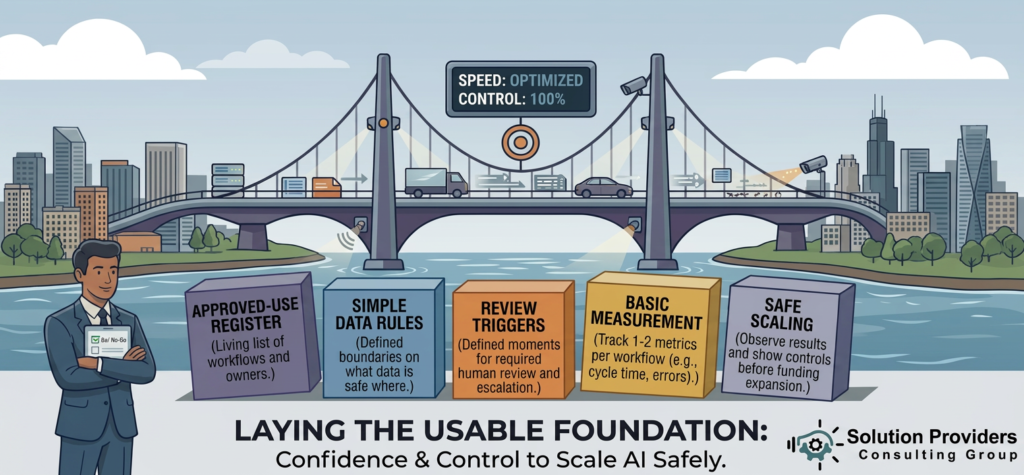
- You can’t scale what you can’t observe. Leaders won’t fund expansion when the program can’t show controls and results.
Here’s the good news: you don’t need heavyweight processes to get control. You need lightweight, repeatable habits:
- A short approved-use register. A living list of the 5–10 workflows you’re actively using AI for (and the owner).
- Simple data rules in plain language. ‘Never paste regulated data into unapproved tools’ beats a 20-page policy nobody reads.
- Review triggers. Customer-facing, regulated data, money decisions, HR, or security = human review and escalation.
- Basic measurement. One or two metrics per workflow (time saved, cycle time, error rate, tickets avoided).
If that sounds almost too simple, that’s the point. Mid‑market execution wins by being clear and consistent—not by building a governance machine.
Next post, we’ll get very specific about the thing that quietly undermines all of this: “data boundaries”—what’s safe to use where, and how to keep teams productive without taking risks you can’t defend.