If you want the business to trust AI output, you have to define what ‘good’ means. Not in theory—in the exact places where AI touches customers, money, and decisions.
Here’s a quiet reason a lot of GenAI rollouts stall: people try it, get a few answers that are ‘almost right,’ and then they stop using it. Not because they’re anti‑AI – but because they’re protecting their time and reputation.
When leaders tell me, ‘The output is inconsistent,’ I can relate, as I have seen it myself. Then I usually ask a simple follow‑up: ‘Inconsistent compared to what standard?’ If the standard isn’t written down, every review turns into opinion, and adoption dies in committee, and money is wasted.
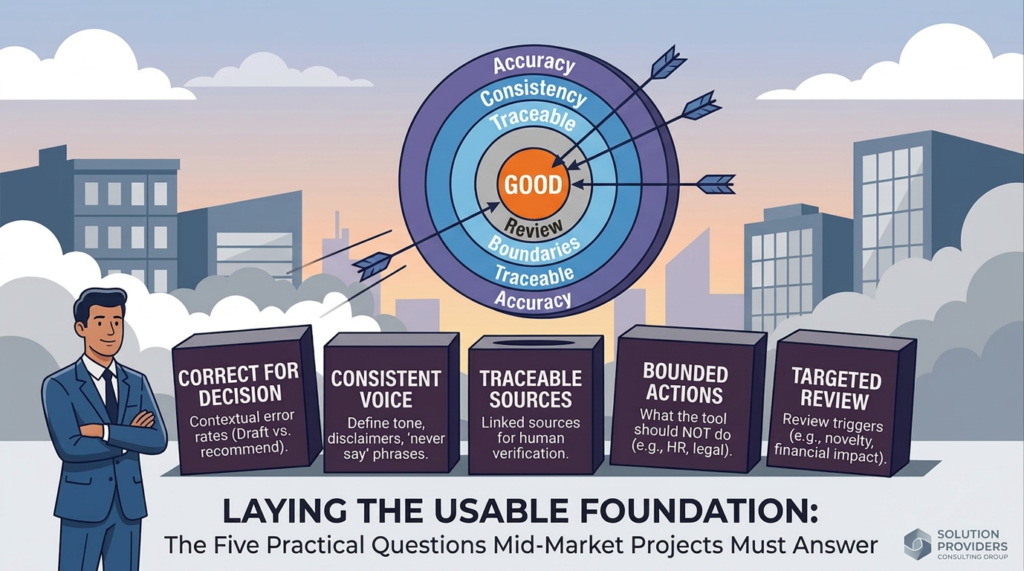
So, before you adopt or scale anything, define ‘good’ results in a way your team can actually use. I like to keep it practical and tied to the work:
- Good = Correct enough for the decision. Are we drafting an email, summarizing notes, creating an internal FAQ, or recommending an action? The acceptable error rate changes by context.
- Good = consistent voice and tone. If AI writes customer-facing messages, define the tone (direct, calm, no hype), required disclaimers, and ‘never say’ phrases.
- Good = traceable. For anything beyond trivial writing, ‘good’ includes a link back to sources (documents, tickets, policies) so a human can quickly verify.
- Good = bounded. Define what the tool should not do: legal advice, HR decisions, pricing changes, security approvals, or anything that must stay human-owned.
- Good = reviewed at the right moment. Don’t make everything a manual review (that kills speed). Instead, set triggers: customer-facing, regulated data, financial impact, or anything novel.
This is where SMBs and mid‑market teams can actually beat larger enterprises: you can agree on standards faster, train a smaller group, and build muscle memory in weeks—not quarters.
One practical way to start is to write a one‑page ‘Definition of Done’ for your first 2–3 AI workflows. It doesn’t need to be perfect. It just needs to be shared.
Next post, we’ll talk about the other half of trust: ‘who is accountable’ (risk owner, value owner, and escalation), so AI doesn’t become ‘everybody’s project’ and nobody’s responsibility.