
If your AI policy reads like a legal document, operators won’t use it- and adoption will route around it. A minimum viable AI policy is short, specific, and tied to the tools and workflows you actually support.
Let’s say the quiet part out loud: most policies fail for the same reason most diets fail – they’re designed for an ideal world.
SMBs and Mid‑market teams are busy. If the rules aren’t obvious, people will either stop using AI or use it in ways you can’t defend.
So, here’s the goal for a minimum viable AI policy:
- Readable in 3 minutes
- Actionable in 30 seconds (clear yes/no decisions)
- Enforceable without surveillance
- Aligned to real tooling (an approved path)
Think of this as a seatbelt, not a speed limit. It doesn’t slow you down – it keeps small mistakes from becoming expensive incidents.
Below is the structure that works well. You can literally copy/paste this into a one‑pager and fill in the blanks.
1) Purpose
Why does this policy exist?
Examples:
“We use AI to expand capacity and reduce low‑value work – without compromising client trust, confidentiality, or compliance.”
“This policy defines what tools are approved, what data can be used, and when human review or escalation is required.”
2) Approved tools (the ‘go here’ list)
If you want to reduce shadow AI, you have to make the safe option easy. List the tools your team is expected to use:
- Approved AI tools: [list tools + links]
- Approved use locations: company accounts only (no personal accounts)
- Not approved: any AI tool not on the list – until reviewed
3) Data boundaries (Green / Yellow / Red)
Keep this painfully simple:
- Green (OK): public content, de‑identified examples, approved templates
- Yellow (OK only in approved tools): internal SOPs, internal FAQs, non‑sensitive project notes
- Red (never): customer PII, regulated data (HIPAA/PCI/etc), credentials, security configs, legal/HR sensitive info
4) Human review rules (where ‘check your work’ is required)
This is where you protect brand and client trust without over‑governing. A simple rule set:
- Required review before sending/publishing: customer‑facing content, pricing/contracts, HR/legal, security guidance, anything using Yellow data
- Optional review: internal drafts using Green data
- Never autonomous: actions that change systems (configs, scripts, access) without a human validating
5) Output standards (definition of ‘good’)
Even a one‑pager should include a default ‘good’ standard, like:
- Be accurate; don’t guess – flag uncertainty
- Use the company’s tone and templates
- Cite sources/links when making factual claims
- Do not include sensitive data in outputs (even if inputs were clean)
6) Escalation triggers (when to stop and ask)
Give people confidence by telling them exactly when to escalate:
- You think the task involves Red data
- A customer asks for something that sounds like legal, HR, or compliance guidance
- The AI output conflicts with policy, contract, or security best practices
- You suspect the tool used was not approved
7) Ownership (who maintains this)
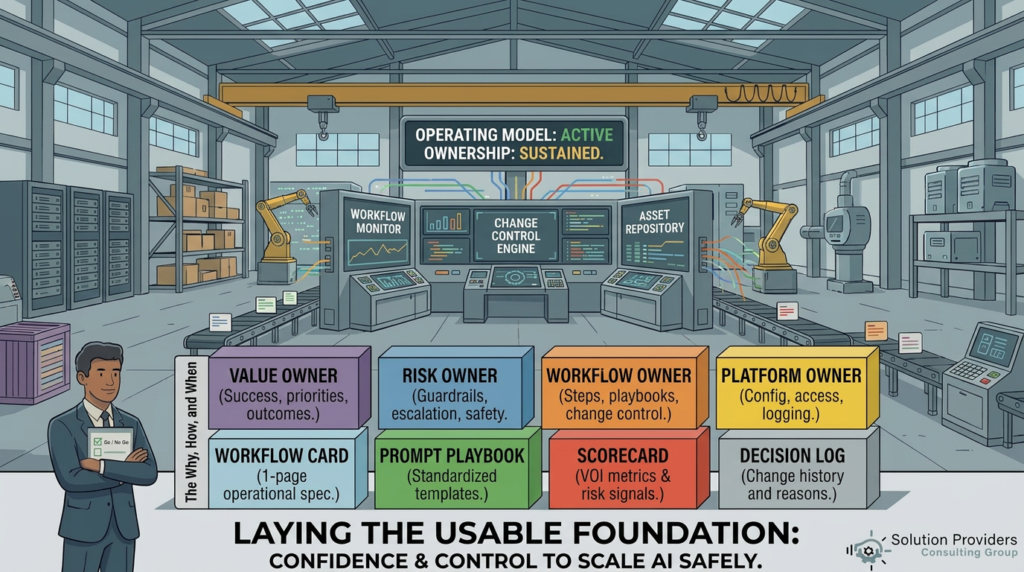
Policies die when they’re nobody’s job. Assign two names:
- Value Owner: accountable for adoption + outcomes
- Risk Owner: accountable for boundaries + controls
8) Change cadence (how this stays current)
Keep it lightweight:
- Review quarterly (or after any incident)
- Update the approved tools list as capabilities change
- Retire workflows that are not producing measurable value
That’s it. One page. Plain language. Clear defaults.
And here’s the key: this policy is only credible if it matches reality – meaning you’ve provided an approved tool path, and you’ve defined the data boundaries you actually expect people to follow.
Next post, we’ll get practical about human‑in‑the‑loop: where review is required vs optional, and how to avoid creating a bottleneck.