
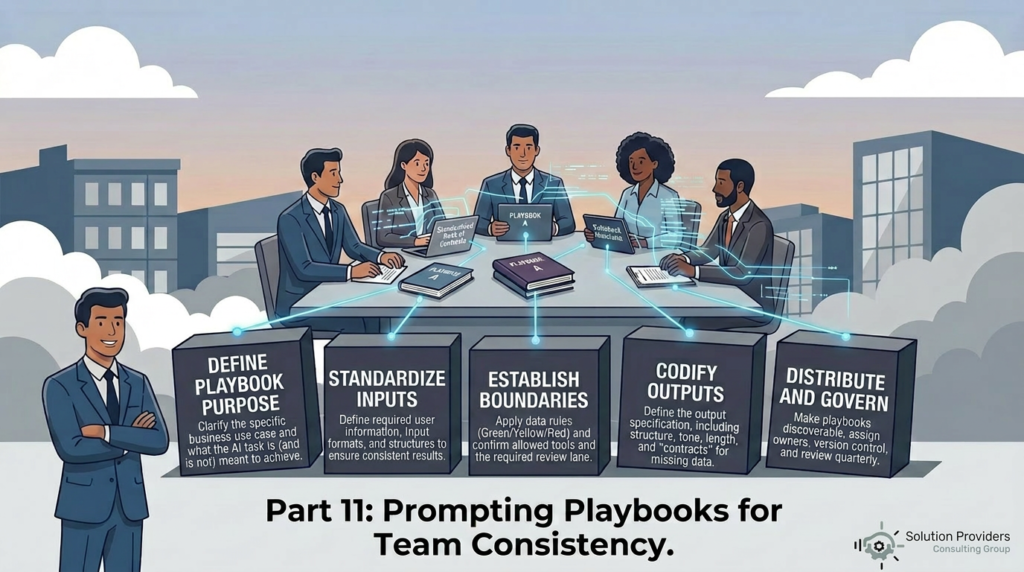
If your AI results depend on one or two power users, you don’t have a capability – you have a fragility. The goal is repeatable outputs that any trained teammate can produce.
Here’s a pattern we see all the time in mid‑market AI adoption:
One person gets great results with AI. Everyone else tries it, gets mixed outcomes, and decides AI is inconsistent.
Both things can be true.
The fix isn’t more enthusiasm – it’s packaging.
Prompting shouldn’t be a personal talent. It should be an organizational asset.
Why ‘hero prompting’ doesn’t scale
When prompting lives in someone’s head, you get:
- Inconsistent quality (different people, different results)
- Unclear accountability (was the output bad, or the prompt?)
- Training debt (every new hire starts at zero)
- Risk drift (people paste in data they shouldn’t because they’re improvising)
The solution is to standardize the work the same way you’d standardize a service desk procedure or a project delivery checklist.
Think ‘prompt playbook,’ not ‘prompt.’
A prompt by itself is rarely enough. A prompt playbook includes:
- Purpose: what this is for (and what it is not for)
- Inputs: what the user must provide (and in what format)
- Data boundaries: Green/Yellow/Red reminders and approved tools
- Output spec: what ‘good’ looks like (structure, tone, length, required sections)
- Review lane: Draft‑only vs Draft+Validate vs No‑Go/Escalate
- Examples: one good example input and one good example output
The simplest reusable structure (copy/paste template)
Here’s a lightweight template you can use for almost any playbook:
- Playbook Name:
- Use Case:
- Lane: (1 Draft‑Only / 2 Draft+Validate / 3 No‑Go/Escalate)
- Approved Tools:
- Allowed Data: (Green / Yellow / Red)
- Inputs (required):
- Constraints: (tone, length, audience, citations, formatting)
- Prompt:
- Validation Checklist: (what to verify before using/sending)
- Example Input:
- Example Output:
Two ‘secret weapons’: input formatting + output contracts
Most prompt failures are actually input failures.
If the model gets messy, missing, or contradictory inputs, you’ll get messy outputs.
So, standardize two things:
- Input formatting: provide a consistent structure (bullet list, table fields, or a short form)
- Output contract: require headings/sections and call out what to do when information is missing
A simple line that improves quality dramatically:
“If you lack required information, ask up to 5 clarifying questions before drafting.”
Make playbooks discoverable (or they won’t get used)
If playbooks live in a random doc nobody can find, people will improvise.
Pick one home for them:
- A shared Teams/SharePoint library with a clear folder structure
- A simple internal wiki page
- A ‘Prompt Library’ in your ticketing/knowledge base system
Then treat playbooks like living SOPs: version them, assign an owner, and review quarterly.
A practical example: QBR narrative playbook for IT
Let’s make this concrete. Here’s what a QBR narrative playbook might enforce:
- Inputs: timeframe, key wins, incidents, top tickets by category, patching summary, security events, next‑quarter plan
- Output: 1‑page narrative with ‘What changed / What it means / What we recommend’
- Constraints: executive tone, no internal jargon, no unverified claims
- Validation: numbers match the report, recommendations align to standards, no sensitive data included
This is how you turn AI from a ‘cool tool’ into a reliable capability: make the best way the easiest way.
Next post, we’ll cover the last piece of the foundation series: operating model- who owns these playbooks, workflows, and controls after the pilot or production rollout, so they stay alive (and keep delivering VOI).