The fastest way to kill AI adoption is to route everything through a single ‘approver.’ The fastest way to create avoidable risk is to route nothing through anyone. The answer is simple – a review map.
When leaders hear ‘human‑in‑the‑loop’, they often picture a heavy approval workflow – tickets, queues, and bottlenecks.
But that’s not what we mean.
In practice, human‑in‑the‑loop is just this: deciding where AI can draft and where a human must validate before it leaves the building.
If you don’t define that, the organization will define it for you. And it will be inconsistent: some people will over‑review everything, others will send outputs straight to clients, and you’ll get a risk profile you can’t explain.
So, here’s a pragmatic way to set this up – without turning it into bureaucracy.
Start with a 2×2: Impact × Reversibility
You don’t need a committee. You need a repeatable decision rule.
Ask two questions about the output:
- Impact: “If this is wrong, what happens?” (minor confusion vs financial/legal/security consequences)
- Reversibility: “Can we easily undo it?” (edit a draft vs change a system / commit to a contract)
High impact or hard to reverse? That’s where a review is required.
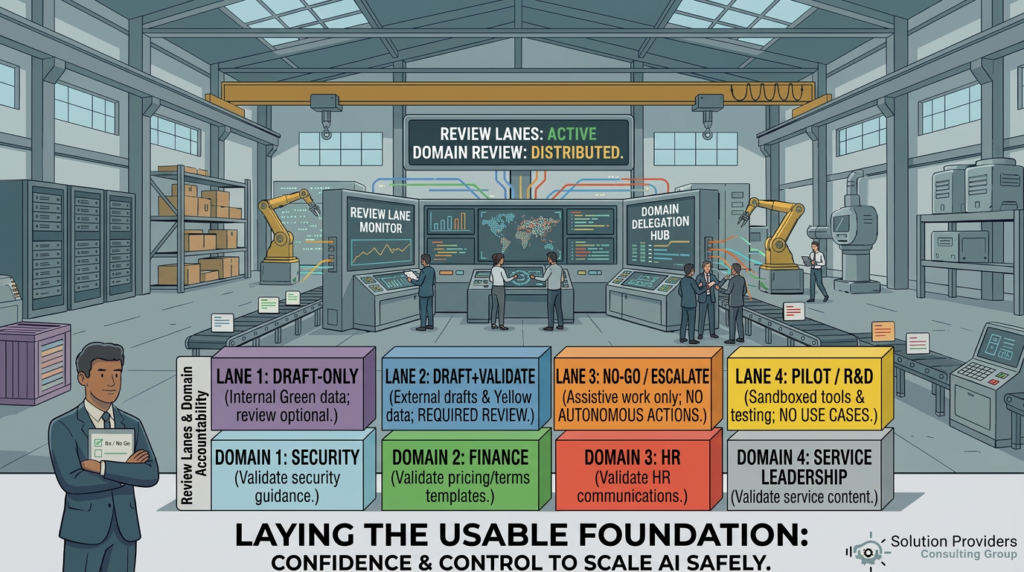
Define three lanes (so people can move fast)
Most mid‑market orgs do well with three lanes. This gives clarity without complexity:
Lane 1: Draft‑Only (review optional)
Use AI to draft, summarize, brainstorm, or structure internal content using Green data.
- Internal meeting notes and action lists
- First drafts of internal SOPs (non‑sensitive)
- Rewrite for clarity, tone, or format
- Summaries of public/vendor documentation
Lane 2: Draft + Validate (review required)
AI can draft, but a human must validate before it is sent externally or becomes an official internal artifact.
This is the sweet spot for safe scaling.
- Customer‑facing emails, proposals, and QBR narratives
- Policies and standards that teams will rely on
- Anything using Yellow data (approved tools only)
- Executive summaries and board‑level communications
Lane 3: No‑Go / Escalate (AI assist allowed, output constrained)
These are areas where you may use AI for ‘assistive work’ (structure, checklists, questions to ask), but you should not treat it as an authority or allow autonomous actions.
- Legal advice, HR determinations, compliance interpretations
- Security architecture or incident response instructions (without security review)
- System changes: scripts, configs, firewall rules, identity/access changes
- Anything involving Red data
Make review lightweight (so it actually happens)
The trick is to review the right things, not to review everything.
A good, required review is fast, specific, and consistent. For example, a simple checklist:
- Did we accidentally include sensitive data?
- Are the facts verifiable (links, sources, internal references)?
- Does the recommendation align with our standards/policy?
- Is the tone appropriate for the audience?
Assign ‘reviewers’ by domain – not a single gatekeeper
Avoid the central approval bottleneck by distributing review to domain owners:
- Security reviews security guidance
- Finance reviews pricing/terms templates
- HR reviews HR communications
- Service leadership reviews customer‑facing service process content
This is how you keep flow – and keep accountability.
The operational win: fewer incidents, less rework, faster throughput
When human‑in‑the‑loop is defined well, you get three outcomes:
- Teams use AI more confidently (because they know the rules)
- Risk is controlled (because review is targeted)
- Outputs improve (because ‘good’ becomes consistent)
If you want a simple implementation approach, start by labeling your top 10 AI use cases into Lane 1/2/3. You can do it in one working session.
Next post, we’ll talk about measurement – how to prove VOI beyond ‘time saved’ and decide what actually deserves to scale.