Last time we talked about why GenAI pilots stall. This week: what I mean by ‘foundation’ – in plain English – so you can move faster *and* reduce risk.
When people hear ‘governance’, they picture a committee, a 40‑page policy, and weeks of meetings. That’s not what I’m talking about.
A usable AI foundation is closer to a set of “shared expectations”- the kind that prevents rework, reduces anxiety, and keeps teams aligned while you learn.
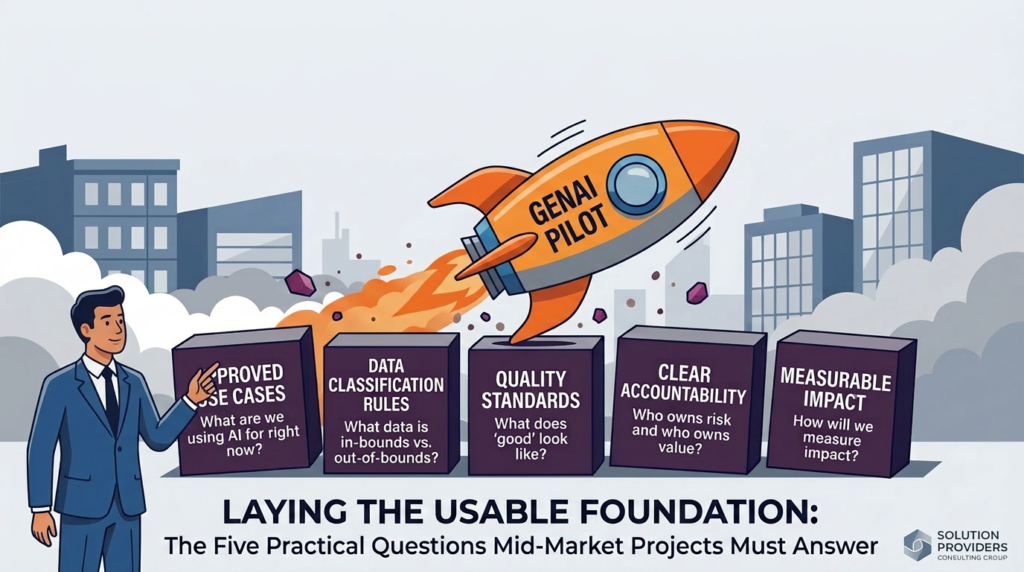
If you strip it down to the essentials, the foundation answers five practical questions:
- What are we using AI for right now? A short list of approved, high-frequency use cases that map to real workflows (not just ‘cool demos’).
- What data is in-bounds vs. out-of-bounds? Not a legal treatise – simple categories: public, internal, confidential, regulated… and what tools can touch each one.
- What does ‘good’ look like? A quality bar: accuracy thresholds, tone guidance, and when a human must review before anything goes to a customer or a decision-maker.
- Who owns risk and who owns value? Two names beat ten stakeholders. One person accountable for safe use, one for measurable outcomes- plus an escalation path when something feels off.
- How will we measure impact? Pick one or two metrics per use case (minutes saved per task, cycle time, error rate, tickets avoided). If you can’t measure it, you can’t scale it.
Notice what’s missing: a platform decision, a big architecture diagram, or a mandate that everyone must use AI. In the mid‑market, the fastest path is usually the simplest one: define expectations, run a few tightly scoped workflows, and measure what changes.
Also notice what this doesn’t do (yet): it doesn’t solve every compliance edge case, or every vendor risk up front. It just prevents the most common pilot killers- unclear rules, fuzzy ownership, and ‘success’ that can’t be proven.
Next post, I’ll go deeper on the most overlooked piece: “defining ‘good’”- so the business trusts the output and adoption doesn’t collapse under skepticism.