Mid‑market leaders are feeling the same push‑pull everywhere: AI promises real productivity gains, but no one wants to trade speed for a data leak, a compliance headache, or a brand hit.
What I’m seeing most often isn’t a motivation problem; it’s a foundation problem. Teams jump into tools, run a few exciting demos, generate some content, automate some basics in marketing or sales, and then… momentum fades. The pilot doesn’t turn into a repeatable workflow. The ‘AI project’ becomes a side quest.
And when the foundation isn’t in place, the failure modes are surprisingly consistent:
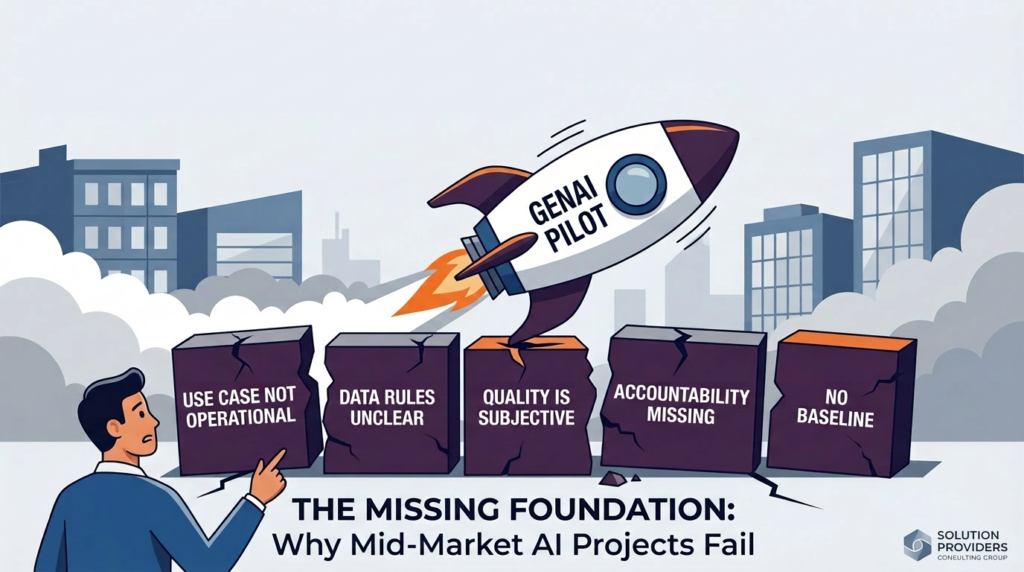
- “The use case is interesting but not operational.” A pilot can look great and still not map to a real process with defined inputs, a named owner, and an outcome the business actually cares about.
- “The data rules are unclear.” People don’t know what’s safe to paste into a tool, what must stay inside approved systems, or what requires redaction. That uncertainty leads to either risky behavior or a full stop.
- “Quality is subjective.” If nobody can answer ‘what does good look like?’, you get inconsistent output quality. Leadership confidence drops fast when the same prompt produces different answers week to week.
- “Accountability is missing.” When there’s no clear owner for risk and no clear owner for value, issues don’t escalate cleanly, and wins don’t get measured credibly.
- “There’s no baseline.” Without a before/after measure (time saved, cycle time, error rate, cost), you can’t prove impact—so the pilot becomes ‘AI theater’ instead of an investment decision.
If this sounds familiar, you’re not alone. Reporting tied to MIT’s Project NANDA has been widely cited for a sobering directional takeaway: roughly “95% of enterprise generative AI pilots fail to deliver measurable ROI or move to production”. Whether your number is 60%, 80%, or 95%, the message is the same—most pilots don’t fail because the model is ‘bad.’ They don’t fail because AI ‘doesn’t work.’ They fail because the foundation wasn’t built for success. In the next post, I’ll unpack what ‘foundation’ really means in plain English—without turning it into a heavy, slow governance program.